|
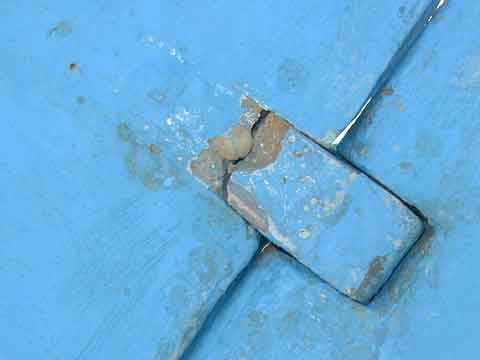 When Al Suwalsky, owner of Good Week #267, asked me to take a look at his rudder, this is what I found. One side of the two-piece gudgeon was completely cracked off. It's a wonder it didn't fall off.
I chipped off the paint and fairing putty and removed the bolts holding it into place. It was clear that work had been done here before, by the protruding nuts on the other side of the keel and by the fact that the bolts were stainless, instead of bronze. I don't recommend stainless below the waterline, because of the danger of crevice corrosion.
 I found that the gudgeon on this boat was formed by welding bronze straps onto a bronze bushing that had been cut in two (not quite in the middle). I doubt that the boat came with this gudgeon from Whitby—I think it was probably replaced some time over the years. The holes were not ideally placed.
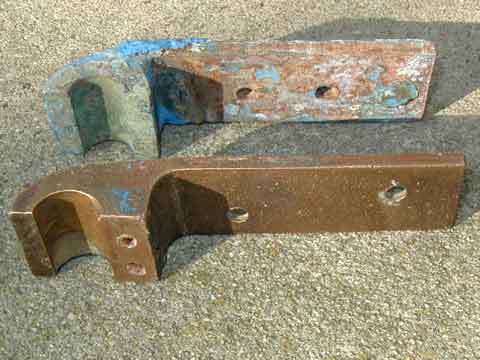 Here we can compare this welded gudgeon with a cast gudgeon which Whitby installed on later boats like mine (hull #543). Notice that the cast gudgeon has offset bolt holes. Flat head machine screws are threaded into the fiberglass keel—not through-bolted with nuts sticking out the other side. The holes are offset, so that the machine screws from each side do not interfere with each other.
Also, there are two smaller holes, tapped on only one of the cast gudgeon halves, where the two sides are bolted together close to the pintle. This makes a strong and rigid arrangement.
By the way, the pin holding the rudder in the shoe was corroded to virtually nothing. I think that this allowed the rudder to be pushed sideways by the force of the water, stressing the gudgeon until it cracked. It's a good argument for checking the condition of underwater components every time you haul the boat and replacing anything that's worn. If one part is not doing its job; it may cause others to fail.
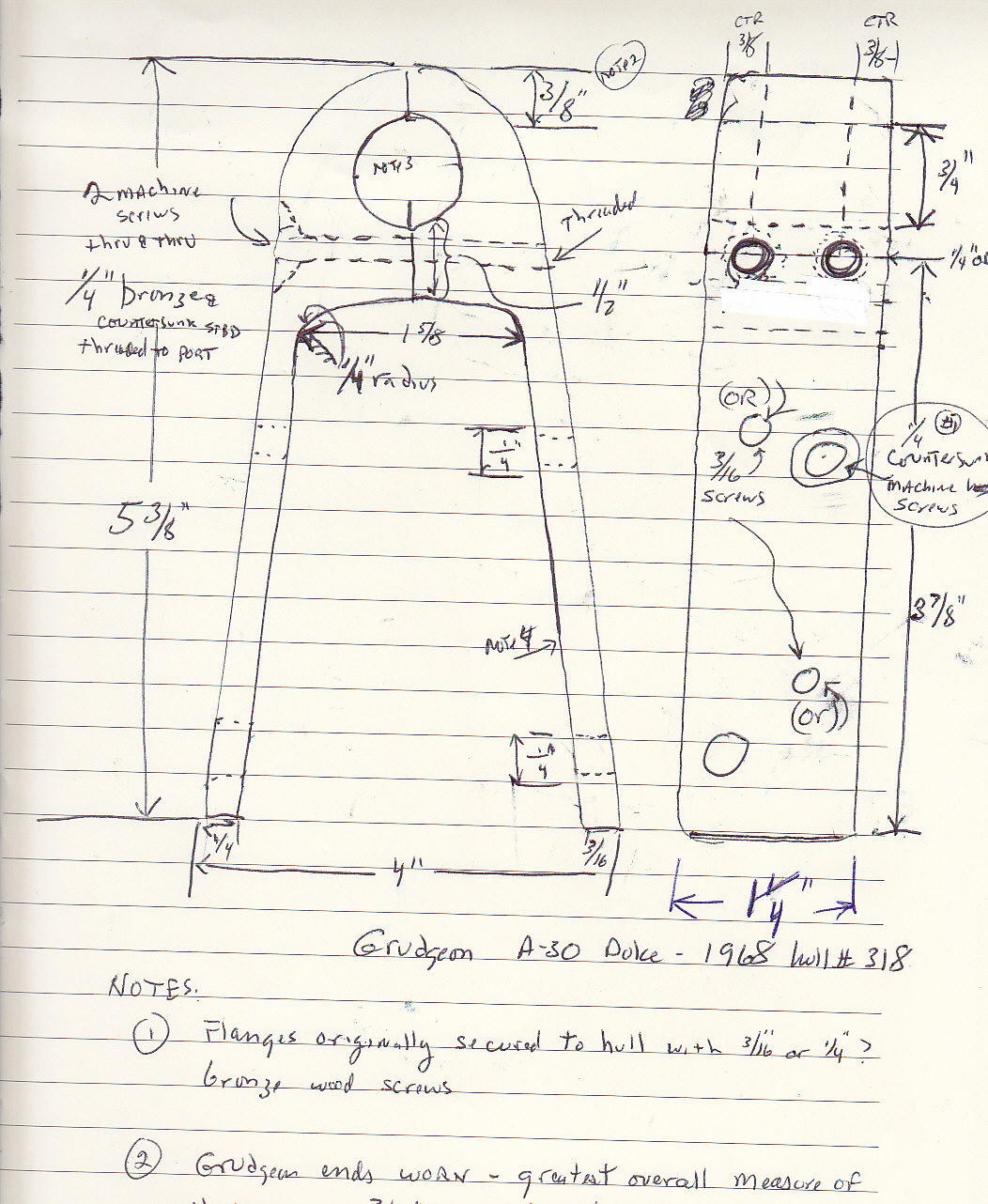
 This sketch (click image for full-size) shows the dimensions of the cast gudgeon, courtesy of Glenn Brooks and his 1968 A30 Dolce, hull no. 318.
Different Hardware on #231
 Michel Taylor sent photos of the pintles & gudgeons he found on #231.
These, instead of being cast, are formed with 1" by 1/2"
bronze straps. As you can see, these parts were quite worn when he measured them. While the hole in the gudgeon was measured at 9/16", I suspect it was orignally 1/2". This splits the difference with the pintle measured at 7/16" diameter.
Michel Taylor sent photos of the pintles & gudgeons he found on #231.
These, instead of being cast, are formed with 1" by 1/2"
bronze straps. As you can see, these parts were quite worn when he measured them. While the hole in the gudgeon was measured at 9/16", I suspect it was orignally 1/2". This splits the difference with the pintle measured at 7/16" diameter.
The gudgeon was mounted on the keel, and you can see it was spread to fit.
 He reports that the pintle may be worn from it's original length and diameter.
The pintle was mounted on the rudder.
 Michael Grosh has a similar pintle and gudgeon on Checkmate #220. He had a replacement gudgeon fabricated at Harvey Foundry, a couple miles behind the Walmart in Easton on Black Dog Alley, for $107.00 in 2022. Michael reports
I was pleased with the workmanship. I took the broken piece to them and they took it from there, an exact fit, except it is in stainless. The man says dissimilar metal electrolysis is not an issue between stainless and bronze.
Subsequent discussion on the public-list did highlight the potential for crevice corrosion on underwater stainless steel. Time will tell how this holds up.
Gordon Laco provides good free advice and entertainment on the Public List

|