Plumbing
 If you want an odor-free head installation on a boat, high-quality hose is extremely important. I went with the Trident #102 rubber sanitation hose. Although it's around $10/foot, that's well worth it for making the boat more liveable. And it's much more flexible and durable than the older PVC reinforced #140, making installation easier.
 But even this hose is not flexible enough for the tight turns needed to tuck the plumbing away out of sight. I looked at Mike Lehman's installation on Gilleleje and, while he hasn't had any problems, I was amazed at the number of hose clamps. Each sharp bend required an elbow and two hose clamps. And the hose-to-hose elbows are sharp bends, indeed. And so, I decided to use PVC pipe.
 Now, PVC pipe is not generally recommended for a boat. Because it is rigid, it will crack as the boat flexes. But I reasoned that if I let the pipe float free, mounted only by the hose connections, I wouldn't suffer any such problems. Time will tell, but the first year looks encouraging.
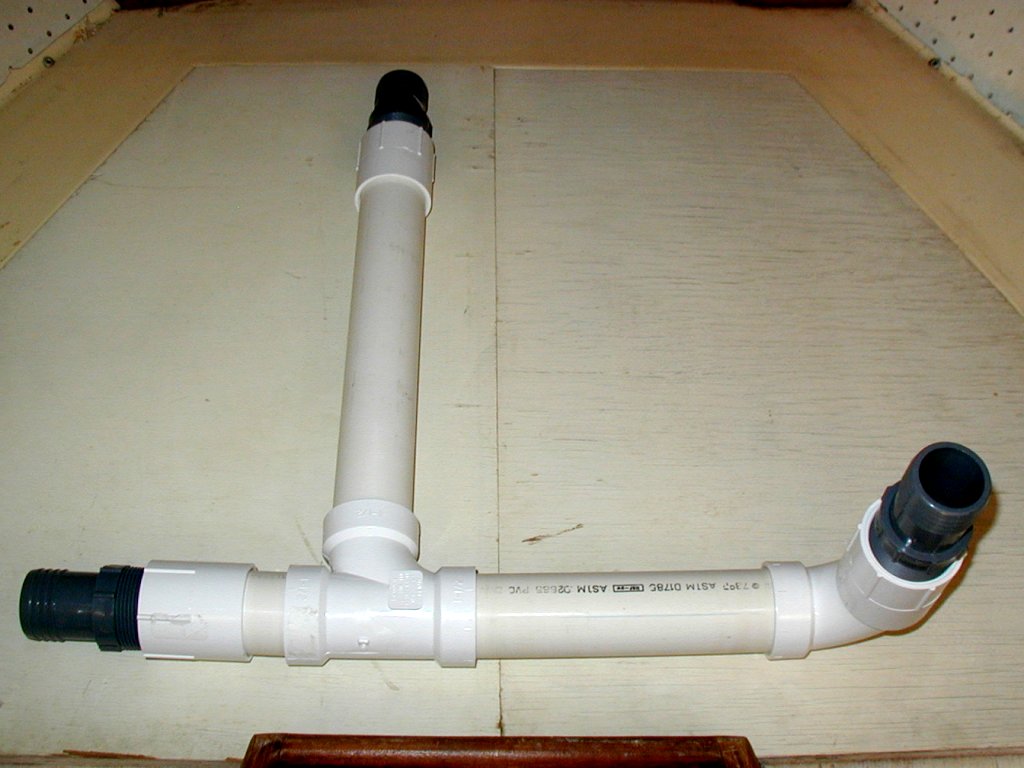
I assembled a collection of 90 degree street elbows, a sanitary tee, female adapters, hose barbs, and pipe all in 1-1/2" size. I made up the assemblies shown, dry-fitted, and then cemented them in situ.
After a decade, the PVC has held up well. I would shape these pipes differently, to reduce the amount of horizontal runs. This tends to take more water than necessary to get solid matter to the tank, and allows solid matter to collect at the bottom of the verticle pump-out pipe.
 The U-shaped assembly connects the head outlet to the holding tank inlet. The Y-shaped assembly connects the holding tank outlet to both the deck pump-out fitting and a Jabsco macerator pump for overboard discharge when offshore or in emergencies. You can see that the deck pumpout is aligned over the existing holes in the shelves where the anti-siphon loop was originally installed.
 The macerator is mounted inside the lower head locker, bolted to the shelf of the upper locker. There is not Y-valve. As long as the hose fittings are air-tight (and they'd better be, anyway) and the through-hull is closed, there is no problem pumping out via the deck fitting. The sanitary Y gives a gentle sweeping curve in that direction to avoid restrictions.
Installation is completed with a 1" connection to the existing through-hull. A 90-degree hose coupling is used to turn the corner from the macerator outlet.
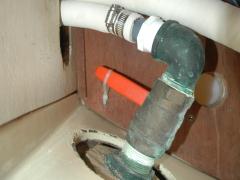 The Jabsco mascerator can output on either side. With the pump mounted upside down like this, I had to disassemble it and mount the outlet on the opposite side from the way it came from the factory.
At the through-hull, I used a reducing coupling to match the existing plumbing. A plastic wire-tie, screwed to the bulkhead, legally locks the seacock handle for inshore sailing.
-- George Dinwiddie, Calypso, #543
Special thanks to Mike Lehman of Gilleleje, #505, and Jim Mennucci of Quest, #433, who blazed the trail with the Kracor tank.
Please support this business that supports the Alberg 30 Association:

|